

No, the Democrats' Big Climate Law is Not Dead.
Plus, new research shows that its clean energy manufacturing boom benefitted Democrats in the 2024 election.

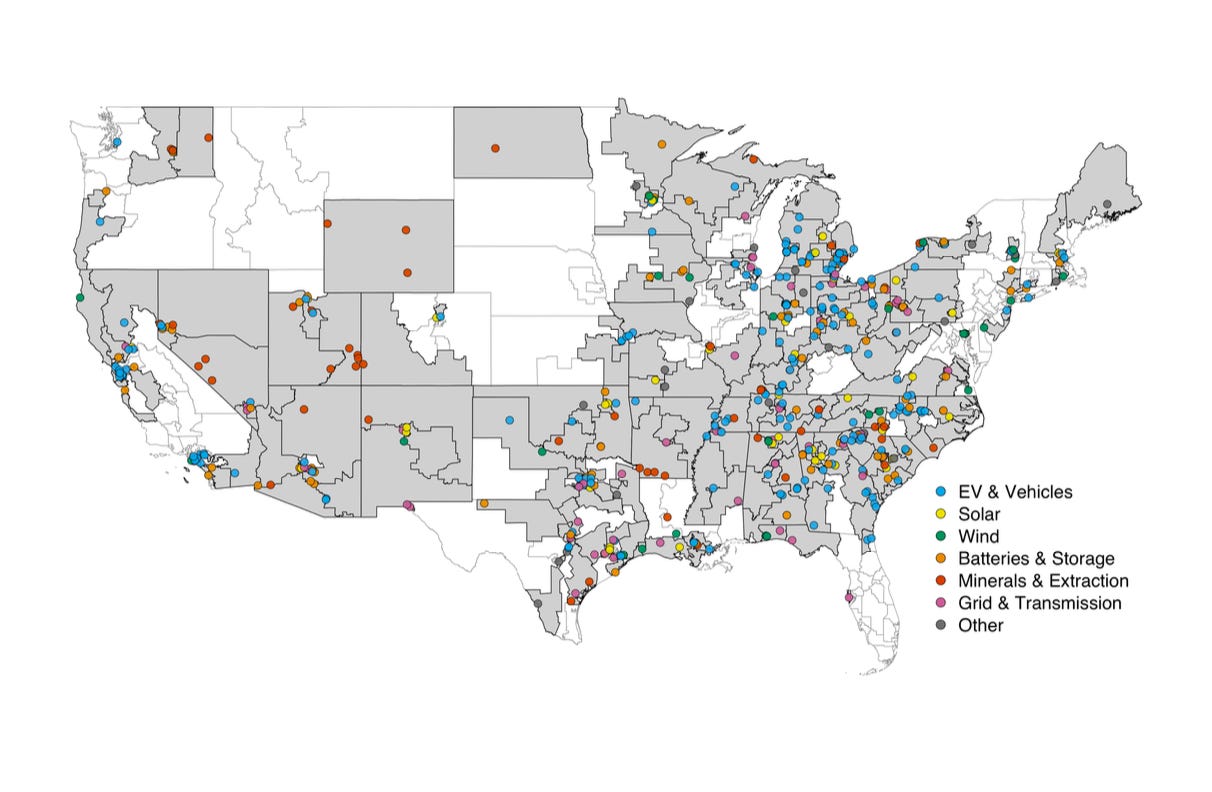
Rumors of the Inflation Reduction Act’s death have been greatly exaggerated. Headlines declared the Democrats’ big climate law dead soon after Republicans passed their One Big Beautiful Bill Act last summer. But the truth is, much of the law is still alive.
Today, I have a story in The Atlantic that explains this in detail. Here’s the gift link to check it out if you’re interested.
In today’s newsletter, I provide more of the context behind that article, unpacking what’s still standing from the Inflation Reduction Act after Trump’s attacks — the factories, the tax credits, and the court rulings keeping them alive.
New Study: How Investments in Clean Energy Manufacturing Helped Democrats Politically
Over the past few months, I’ve been working on an econometric study that looks at the manufacturing renaissance the Inflation Reduction Act kicked off. We found that the law helped drive $185 billion in private investment into building factories that make solar panels, batteries, and electric vehicles. And here’s the amazing thing most people don’t know: nine in ten of those facilities are still getting built, under a president who promised to kill them.
Those factories moved votes. We find they lifted Democratic vote share by roughly 1.5 percentage points in 2024 — a swing of 2.5 million votes, in an election where Trump won the popular vote by just 2.3 million. You can read the full study here.1
These clean energy plants weren’t built in Berkeley or Brooklyn. They went up in manufacturing towns that have been slipping away from Democrats for a decade. And as our study shows, that’s exactly where this policy won them votes. Pundits keep insisting that climate is how Democrats lose factory towns. A close look at the data shows the opposite: Democrats are winning back factory towns with climate investments.
Political scientists call this policy feedback: laws create their own politics, building support that makes them hard to roll back. For many of the law’s tax credits, which were fully implemented, policy feedback worked. For the grants — many still unspent when Republicans took over — it didn’t. And that shouldn’t surprise us. If a policy is never implemented, it can’t be expected to reshape politics.
You can see this dynamic at work in what survived Trump’s repeal bill and what didn’t.
The Tax Credits for Clean Energy Largely Survived—Especially the Corporate Credits
For the tax credits, policy feedback worked. But interestingly, it worked much better for corporations than for everyday people. Consumer-facing credits — which gave families a tax break for installing clean technologies like solar panels or heat pumps — were erased. But tax breaks for companies lived on. The investment tax credit for solar and wind survived, albeit wounded. Battery storage made it out relatively unscathed. And so did the manufacturing tax credits. These tax credits were the law’s largest by far. Hence those factories are still being built.
It’s not surprising that Trump and the Republican party care more about corporations than normal people. But it also speaks to how clean energy corporations organized to defend the credits. Renewable energy companies and industry associations launched a lobbying blitz on Capitol Hill, making the case to Republican offices that these provisions were worth keeping. At the start of the 119th Congress, over 1,500 solar and storage companies sent a letter to congressional leaders imploring them to protect the solar, storage, and manufacturing credits. The consumer credits, by contrast, did not have the same activated, well-resourced base of support. The beneficiaries of these credits were much more diffuse, going to a wide range of households across the country, making it harder to organize and ensure the credits survived.
The Republican party could theoretically become clean energy champions, too. And reap the political rewards. The returns are there for whoever defends these investments — and some, like those who signed letters defending the tax credits, are starting to try.
Perhaps the IRA’s deepest legacy is one Trump cannot easily reverse: it helped make clean energy cheaper. Cost declines work like a ratchet — every factory built and every panel installed pushes prices down the learning curve, and once they fall, they do not climb back up. Since the IRA passed, battery prices have dropped by a third, hitting another record low last year. A tax credit can be repealed. A price decline cannot — the learning is permanent. The best Trump can do is tax clean energy: his tariffs on imported solar panels and batteries force Americans to pay more for technology than the rest of the world does. He cannot make clean energy expensive again. He can only make Americans pay extra for it.
As someone who worked a lot on the consumer credits to help everyday Americans get a heat pump, I should be particularly depressed that they were lost. Instead, I know how flawed they were. The credits gave people $600 to buy an “efficient” gas furnace, up from $150 before the law passed — and a maximum of just $2,000 for a heat pump, when they cost far more. The results were predictable. In the credit’s first full year, more families used it for gas furnaces than heat pump HVAC: 283,390 to 267,780. Even the gas industry celebrated.2
The repeal of this tax credit provides an opportunity to get it right next time. We should eliminate any gas furnace subsidies entirely, and increase the heat pump support to 30% of the full cost, uncapped—as was the case for solar and batteries. We should also make them more accessible for lower income Americans by making them “direct pay”— allowing people with little to no tax liability to access them.
Trump’s Undeniable Assault on Clean Energy
Realizing their megabill hadn’t killed the clean energy tax credits, the Trump administration went further, issuing an executive order that directed the Treasury to rewrite the rules so fewer projects could qualify. A coalition of consumer advocates, tribes, and local governments took the administration to court. In June, a federal judge threw out Trump’s new rules as “arbitrary and capricious,” restoring the ones developers had relied on for a decade. The administration even required Interior Secretary Doug Burgum to personally approve every wind and solar project on federal land — dozens of permitting steps on one man’s desk. Again, a federal judge rejected that earlier this year.
While many of the IRA’s tax credits got out the door, the Trump administration gutted many of its grants that had not yet been fully implemented, notably $20 billion for the creation of a green bank. The green bank was supposed to drive clean energy investment into disadvantaged communities and build new constituencies for climate action. But a policy that is never implemented cannot create policy feedback.
That’s why, when the time comes to pass another climate law, grant money needs to get out the door faster. Communities can’t protect policies they can’t see. And they won’t reward politicians for benefits they don’t get.
Stokes, L.C., & Lomov, D. (2026). Electoral Returns from Climate Policy: The Effect of the Inflation Reduction Act’s Manufacturing Investments. SSRN: https://ssrn.com/abstract=7226779.
Though another 104,180 families used the tax credit for heat pump water heaters that first year—and given they are less expensive, the credit was more valuable than for HVAC heat pumps.