

Yes, Democrats Should Talk About Climate.
Talking about Climate Change is a Political Winner.

Welcome to Notes from the Electric Era, a newsletter from me, Leah Stokes, on building an electrified, abundant clean energy future.
In the weeks and months ahead, I’ll tell stories about clean energy and electrification, and examine the politics behind climate policy. I’ll be drawing on research from political science and public policy, informed by the latest energy statistics.
If you’d like to support my work, become a free or paid subscriber. The newsletter will be available at electricnotes.news.
Yes, Democrats Should Talk About Climate.
Democrats have stopped talking about climate change. In 2021, 1 in 9 of their press releases mentioned it. This year, it appeared in just 1 in 50 — a mere 2 percent.
This won’t surprise anyone paying attention. In recent months, a consensus has emerged among analysts and political operatives: no one cares about climate change. If politicians bring it up, they should do it in hushed tones. It’s an albatross around the Democratic Party’s neck.
Except it’s not true.
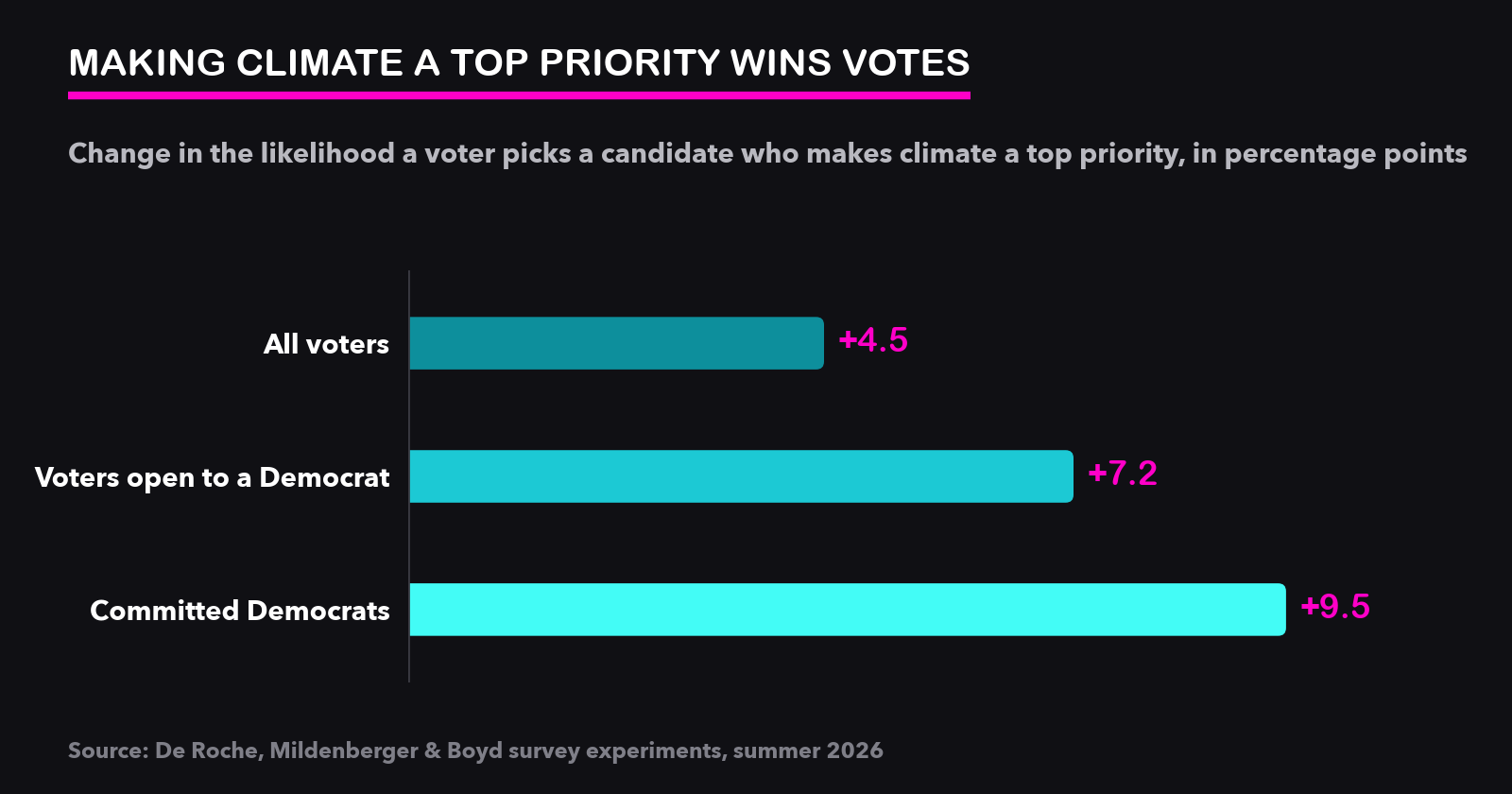
My colleagues at UC Santa Barbara, Gabriel De Roche, Matto Mildenberger, and Lucas Boyd, just surveyed roughly 3,500 Americans this summer. They showed voters pairs of hypothetical candidates and asked them to pick which one they’d vote for. Candidates who made climate a top priority got a 4.5-point bump. Among voters open to supporting a Democrat, the bump grew to 7.2 points, and among committed Democrats it was 9.5. Elections are decided by far less.
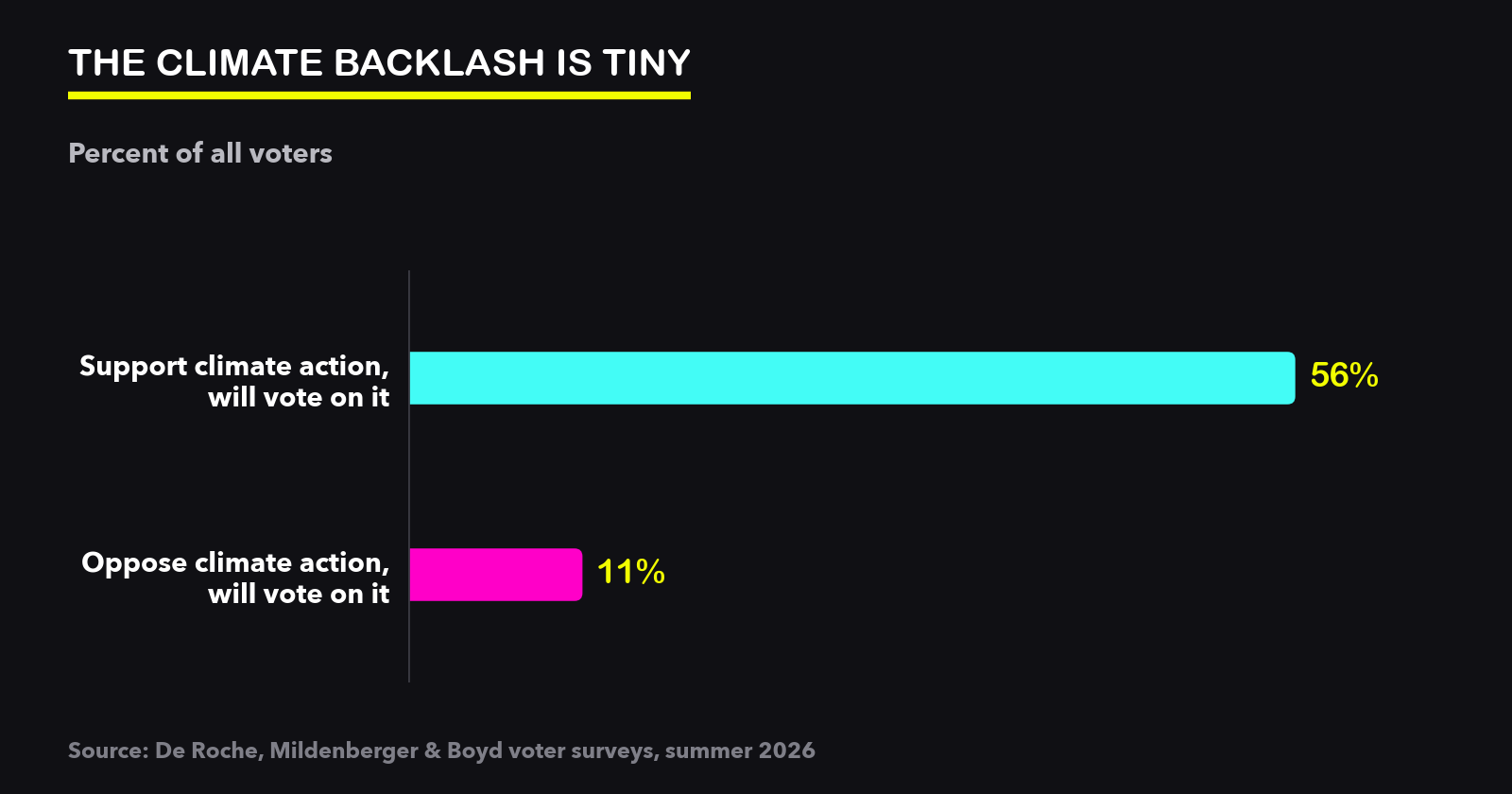
Climate supporters are also far more motivated. While over half of voters back climate action and say they’ll vote on it, barely 1 in 10 oppose it and say the same. Going quiet on climate panders to a sliver of the electorate while writing off a much larger group of winnable voters.
Skeptics will point out that voters rank “the economy” above “climate.” But rankings only measure what’s top of mind. They don’t tell you what voters want done — or what wins their vote. Still: climate now sits fourth among Democratic voters on The Economist’s tracker — behind only inflation, health care, and jobs. I particularly like that indicator because it uses consistent wording over time and they have data going back years.
Depending on the question wording, climate can rank lower — it does in my colleagues’ survey. But the point is this: how high someone ranks climate on a survey is not very relevant. Whether they will vote on it is. And besides: rankings go down when politicians stop talking about an issue and the media stops covering it.1
You can explore the rest of my colleagues’ survey data here.
If I were running for Congress this fall, here’s how I would talk about climate change.
The message isn’t complicated. We know what works: we’ve known for years.2 Explaining how clean energy lowers energy bills, cuts pollution, and creates jobs is the winning formula.
First I would focus on affordability, because Trump’s climate reversals are already taking dollars out of Americans’ pockets. We can all see our electricity bills are too high. And Trump is pushing them higher by forcing families to bankroll expensive coal plants past their planned retirements. The tab so far: more than $300 million, tacked onto power bills across the country. One Michigan plant alone costs families $615,000 a day. Ratepayers could end up paying $6 billion a year to keep dirty, overpriced energy on life support.
Trump’s war in the Middle East has already cost the average family more than $525 at the pump. Add higher electricity and gas bills, and the Trump energy tax is on track to reach roughly $1,500 per household this year.
And that doesn’t count home insurance. Premiums have jumped 57 percent since 2019, rising fastest where climate disasters hit hardest. Trump is giving handouts to the fossil fuel industry and sticking Americans with the bill.
Meanwhile, clean energy costs continue to fall. We could replace almost every single coal plant in this country with wind and solar and save people money.3 Yet Trump is blocking that cheap power — requiring his Interior secretary’s personal signature on 69 separate permitting steps for every single wind and solar project under federal review. He is forcing families to buy the most expensive power on the grid while blocking the cheapest.
Democrats should say it plainly: Trump’s corrupt handouts to the fossil fuel industry are jacking up Americans’ energy bills and driving climate chaos.
Next I would talk about pollution. The Trump administration set up an email address where polluters could simply ask to be excused from clean air laws. Already, 71 coal plants have been given a free pass on tougher limits for mercury — a poison that damages babies’ developing brains. The administration also moved to gut 31 pollution rules in a single day. These rollbacks will cause nearly 200,000 Americans to die early.
Trump’s countless decisions to prop up fossil fuels while blocking clean power is driving up climate pollution. That pollution shows up at our doors: heat waves that kill, skies that turn orange, and fires that take out whole neighborhoods. It’s not a hard argument to make if you’ve lived on planet earth for the past month.
And I would focus on jobs. The Democrats’ Inflation Reduction Act drove clean energy manufacturing into districts across the country, creating hundreds of thousands of jobs. And believe it or not, 9 out of 10 of these facilities are still moving forward.4
But Trump is doing his best to kill them. In 2025, Trump’s policies resulted in $29 billion worth of canceled manufacturing, which would have created 39,000 new jobs. Democrats can rebuild the clean economy with good-paying jobs. And they should talk about that.
It’s true, there are so many issues right now, and it’s hard to break through. But climate connects them: rising energy costs, more deadly pollution, and fewer good-paying jobs. Even the Reflecting Pool’s algal bloom — one of the hottest topics of the day — can be linked back to climate change.
There are already Democratic candidates showing us how to talk about climate.
Will Lawrence, a climate and rent control advocate running for a House seat in Michigan, is the very embodiment of the idea that we don’t have to choose between talking about affordability and climate. He leads with utility bills, while reminding voters that solar is the cheapest power we can build. When he talks about data centers, he focuses on job losses and pollution. Lawrence is running a competitive campaign in one of the nation’s most closely watched primaries, and is currently ahead in the polls.
In North Carolina, Roy Cooper is running for Senate on his clean manufacturing record. As Governor, he landed a $14 billion battery plant and created more than 20,000 clean energy jobs. He pitches it as a win for “planet, people and pocketbooks.” Now he’s likely to flip a Republican-held Senate seat this fall.
Hard as it may be to believe, research consistently shows that the public listens to politicians.5 So when Democrats stop talking about climate change, the public thinks about it less. Politicians’ silence also reduces media coverage. Last year, broadcast news aired just eight and a half hours of climate coverage, a 62 percent drop from the peak in 2022. Newsrooms are cutting their climate teams.
But even if politicians keep ignoring it, the climate itself will make sure we can’t. We are entering an El Niño year, and it could be one of the strongest ever. As the last month has already shown, heat waves will be deadlier, floods bigger, and wildfires more devastating. Whether or not Democrats utter the word, climate disasters will keep coming for people’s homes, savings, and even their lives. And voters will continue to notice: the smoke in the air and the endless hot days will make it impossible not to.
References:
Iyengar, S., & Kinder, D. R. (2010). News that matters: Television & American opinion. University of Chicago Press.
Stokes, L. C., & Warshaw, C. (2017). “Renewable energy policy design and framing influence public support in the United States.” Nature Energy, 2(8), 1-6.
Gimon, E., Solomon, M., O’Boyle, M. (2023). “The Coal Cost Crossover 3.0.” Energy Innovation.
The Clean Economy Tracker, Atlas Public Policy.
Lenz, G. S. (2013). Follow the Leader?. University of Chicago Press.